


Comprehensive AI Implementation & Governance Checklists for Enterprise Risk Management
This article examines the essential elements of AI implementation and governance checklists and presents a structured methodology for managing enterprise risk. It summarizes governance frameworks, project management checklists, risk management best practices, regulatory compliance considerations, and performance optimization metrics. As organizations increase AI adoption, robust governance frameworks are required to mitigate risks and enhance operational efficiency. The guide outlines how to develop and implement these frameworks to enable effective navigation of AI adoption complexities.
What Constitutes an Effective AI Governance Framework?
An effective AI governance framework is a structured system of policies, procedures, and standards that govern AI development and deployment to ensure alignment with organizational objectives and regulatory requirements. Its primary advantage is the establishment of stakeholder trust, which supports adoption and oversight. By addressing adoption inhibitors and promoting transparency, such frameworks create conditions that support managed, responsible innovation.
Key Components of AI Governance Frameworks in Enterprises
Core components include operational transparency, adherence to ethical standards, and systematic stakeholder engagement. Transparency enables explainability and accountability in AI operations. Ethical standards define acceptable use and guardrails. Continuous stakeholder engagement throughout the AI lifecycle helps surface concerns and improves governance effectiveness.
How AI Governance Ensures Responsible and Compliant AI Adoption
AI governance frameworks codify guidelines that promote ethical practices and regulatory compliance while balancing innovation with risk mitigation. They identify facilitators and inhibitors of adoption and, when operationalized, reinforce stakeholder confidence to ensure AI technologies are deployed responsibly and in accordance with applicable requirements.
How to Develop and Implement an AI Project Management Checklist?
A project management checklist ensures AI initiatives align with corporate objectives and governance obligations. A well-structured checklist functions as a roadmap for project teams across implementation phases and provides checkpoints for risk identification, compliance verification, and performance validation.
Step-by-Step AI Implementation Checklist for Digital Transformation Governance
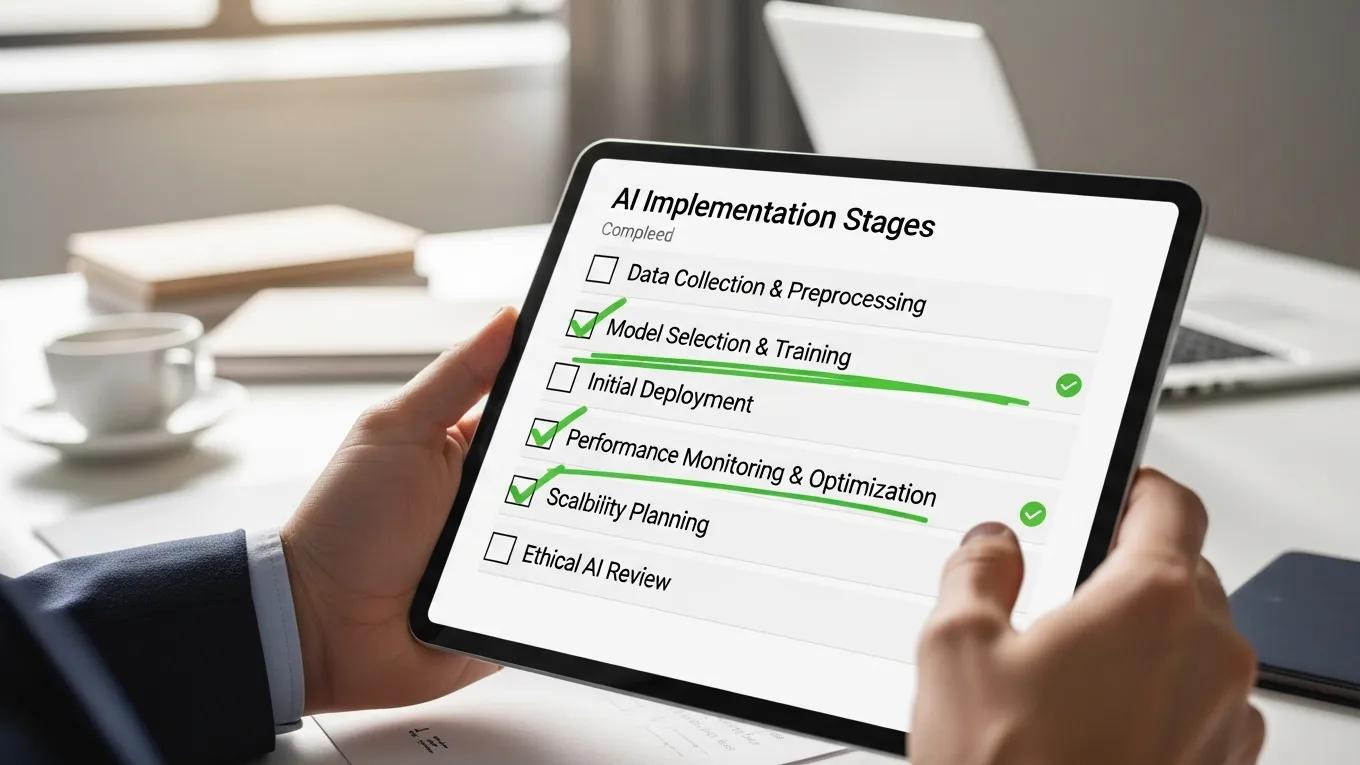
A practical AI implementation checklist should include the following steps:
- Establish Governance Policies: Define clear policies that outline the roles and responsibilities of stakeholders involved in AI projects.
- Engage Stakeholders: Involve relevant stakeholders early in the project to gather insights and address concerns.
- Monitor and Evaluate: Continuously assess the progress of AI initiatives against established benchmarks to ensure alignment with governance standards.
Integrating Risk Management Strategies into AI Project Checklists
Embedding risk management strategies into AI project checklists is essential for identifying and mitigating risks across the project lifecycle. Principal strategies include systematic risk identification, defined mitigation techniques, and continuous monitoring processes to enable timely adjustments.
- Risk Identification: Conduct thorough assessments to identify potential risks associated with AI technologies.
- Mitigation Techniques: Develop strategies to address identified risks, ensuring that appropriate measures are in place to minimize their impact.
- Continuous Monitoring: Implement ongoing monitoring processes to track risk factors and adjust strategies as needed.
What Are Best Practices for Enterprise AI Risk Management?
Best practices require a proactive approach to identify, assess, and mitigate AI-related risks. Organizations should implement governance frameworks that integrate risk management processes and ensure AI initiatives remain aligned with strategic business objectives.
Identifying and Assessing AI Risks in Enterprise Systems
Risk identification and assessment require structured frameworks that evaluate factors such as data privacy, algorithmic bias, and operational impact. Applying standardized assessment methodologies and engaging relevant stakeholders yields a clearer view of risk vectors and their implications.
Mitigation Techniques and Monitoring for AI Risk Management

Mitigation techniques include deploying robust monitoring systems, establishing documented incident response protocols, and maintaining procedures for periodic review. Organizations should institutionalize continuous improvement by reviewing and updating risk strategies to address evolving threats. Case studies of implemented mitigations provide practical guidance on effective approaches.
Integration of AI capabilities enables proactive risk management functions that extend beyond traditional reactive methods.
AI for Proactive Project Risk Management & Mitigation
Risk management in critical infrastructure and national security projects is a fundamental requirement for operational resilience, security, and stability. Traditional approaches that rely primarily on historical data analysis and expert judgment have limitations when addressing dynamic and evolving threats. Artificial intelligence offers advanced capabilities in predictive analytics, autonomous mitigation, and real-time decision support. This study examines the integration of AI technologies—including machine learning (ML), natural language processing (NLP), deep learning, and predictive analytics—into risk management frameworks to enhance threat identification, response efficiency, and resilience. The research highlights AI’s role in shifting risk management from reactive to proactive strategies by enabling organizations to anticipate and mitigate risks before they escalate.
AI-driven project risk management: Leveraging artificial intelligence to predict, mitigate, and manage project risks in critical infrastructure and national security projects, MI Faruk, 2025
How to Ensure AI Compliance with Regulatory and Ethical Standards?
Compliance with regulatory and ethical standards is a central element of AI governance. Organizations must develop comprehensive compliance checklists that reflect current regulations and ethical guidance to ensure that AI systems are deployed in a legally and ethically defensible manner.
Developing an AI Compliance Checklist Aligned with 2024-2026 Regulations
An AI compliance checklist should include the following components:
- Regulatory Alignment: Ensure that AI initiatives comply with relevant regulations, including data protection and privacy laws.
- Checklist Components: Define specific criteria that must be met for compliance, including documentation and reporting requirements.
- Stakeholder Involvement: Engage stakeholders in the compliance process to ensure that all perspectives are considered.
Detailed compliance checklists translate complex legal requirements into actionable steps for engineers and project managers.
AI Compliance Checklists & Risk Management Duties
This chapter converts the Act’s legal text into an engineer-oriented blueprint. It details risk management duties (Art. 9), data governance and bias mitigation rules (Art. 10), transparency obligations (Arts. 13 and 52), human oversight mandates (Art. 14), technical robustness standards (Art. 15), conformity assessment pathways and CE marking (Arts. 11, 17, 43, 47), and post-market monitoring (Art. 61). Summaries, flowcharts, and compliance checklists enable practitioners to audit existing systems or design new ones that meet the regulation’s letter and intent. Penalties and enforcement mechanisms (Arts. 71–73 and 99) are also outlined to emphasize the cost of non-conformity.
Compliance Requirements, M Kauffman, 2025
Incorporating AI Ethics Guidelines into Governance Frameworks
Incorporating ethics guidelines into governance frameworks is necessary to ensure responsible AI use. Organizations should establish governance committees charged with developing policies that address ethical considerations across design, deployment, and operations. This structured approach supports accountability and helps organizations manage ethical complexity.
Subsequent research underscores the multifaceted nature of ethical AI governance, covering security, compliance, and bias mitigation.
Ethical AI Governance: Security, Compliance & Bias Mitigation
This paper examines the ethical dimensions of AI in enterprise automation, emphasizing the need to balance security, regulatory compliance, and bias mitigation. AI technologies are transforming industries by optimizing operations, enhancing decision-making, and reducing costs. Their adoption also presents ethical challenges related to data security, compliance with evolving regulations, and the risk of biased outcomes. The study reviews literature, industry practices, and case studies to provide insights into these concerns. It emphasizes transparency, accountability, and continuous oversight, and proposes an ethical framework that integrates fairness, privacy, security, and accountability into AI system design. Addressing these elements enables organizations to deploy AI in ways that maintain public trust.
Ethical AI in Enterprise Automation: Balancing Security, Compliance, and Bias Mitigation, 2025
Which Metrics and KPIs Optimize Enterprise AI Performance?
Selecting appropriate metrics and key performance indicators (KPIs) is essential to optimize enterprise AI performance. These measures provide objective insight into model effectiveness and operational impact, supporting data-driven decisions.
Key Performance Indicators for Monitoring AI Implementation Success
Key performance indicators for monitoring AI implementation success include:
- Performance Metrics: Assess the accuracy and efficiency of AI models to ensure they meet organizational objectives.
- Monitoring Techniques: Implement techniques for tracking AI performance over time, allowing for adjustments as needed.
- Stakeholder Feedback: Gather feedback from stakeholders to evaluate the impact of AI initiatives on business operations.
Using Data-Driven Insights to Enhance AI Governance Outcomes
Data-driven analysis is central to improving AI governance outcomes. Organizations should apply analytics to detect trends and performance patterns, enabling informed decisions on program adjustments. Effective use of data strengthens governance controls and optimizes AI performance.
What Are Common Challenges and Solutions in AI Governance Implementation?
Common implementation challenges include organizational resistance, insufficient stakeholder engagement, and constrained resources. Addressing these challenges is necessary to enable successful and sustainable AI adoption.
Overcoming Organizational Barriers to AI Governance Adoption
Overcoming organizational barriers requires a strategic approach that emphasizes transparency and structured communication. Clearly articulate governance objectives, involve stakeholders in decision processes, and provide governance-related training to build trust and facilitate adoption.
Case Studies Demonstrating Effective AI Governance Solutions
Case studies of implemented AI governance solutions offer practical examples of effective strategies. These cases illustrate the value of stakeholder engagement, precise communication, and iterative improvement. Organizations can adapt proven approaches to address their specific constraints and objectives.
Frequently Asked Questions
What are the key benefits of implementing an AI governance framework?
Implementing an AI governance framework yields enhanced accountability, improved regulatory compliance, and increased stakeholder confidence. Clear policies and procedures support responsible and ethical use of AI, and structured governance facilitates early identification and mitigation of risks. The result is a governance environment that supports innovation while protecting organizational integrity and reputation.
How can organizations measure the effectiveness of their AI governance?
Effectiveness can be measured using defined metrics and KPIs such as compliance rates with regulatory standards, stakeholder satisfaction indicators, and the incidence rate of AI-related risk events. Organizations should also evaluate alignment of AI initiatives with business objectives and measure operational efficiency gains. Regular audits and structured stakeholder feedback provide additional evidence for performance assessment.
What role do stakeholders play in AI governance?
Stakeholders provide essential perspectives that inform governance decisions, including identification of risks, ethical considerations, and compliance priorities. Early and continuous engagement promotes transparency and ensures governance frameworks address the needs of affected parties. This inclusionary approach enhances the legitimacy and effectiveness of governance measures.
What are some common pitfalls in AI governance implementation?
Common pitfalls include inadequate stakeholder engagement, unclear or incomplete policies, and insufficient resources for governance activities. Resistance to organizational change and failure to maintain continuous monitoring can leave frameworks outdated. To mitigate these pitfalls, organizations should prioritize communication, training, and scheduled reviews of governance practices.
How can organizations ensure ethical AI use in their governance frameworks?
To ensure ethical AI use, organizations should embed ethical guidelines into governance frameworks, covering topics such as data privacy, algorithmic bias, and transparency. Establishing ethics committees to oversee AI initiatives and providing regular training for personnel support compliance with ethical standards and reduce operational risk.
What are the emerging trends in AI governance?
Emerging trends include an increased emphasis on ethical AI practices, integration of AI into compliance frameworks, and greater use of advanced analytics for risk management. Organizations are expanding stakeholder participation in governance and prioritizing transparency and explainability to satisfy both users and regulators.
Conclusion
Implementing a robust AI governance framework is essential for organizations that seek to realize the benefits of artificial intelligence while managing associated risks. Establishing clear policies and engaging stakeholders enhances accountability, compliance, and trust in AI initiatives. This structured approach supports innovation and promotes ethical, responsible AI deployment. Consult our resources to support the development of effective governance strategies.