


Integrating Art and Technology in Practice: Strategic AI Governance and Enterprise Innovation for Executives
The convergence of art and technology is altering industry practices by enabling creative innovation and improving operational efficiency. This paper examines the integration of artificial intelligence (AI) into creative workflows and enterprise systems, with emphasis on AI governance principles and the impact of technology on artistic innovation. It provides evidence-based insights on how AI can streamline workflows, augment creative capacity, and reduce implementation risks. As organizational AI adoption increases, governance mechanisms become critical to balance innovation with ethical and regulatory obligations. The analysis addresses core AI governance principles, the effect of technology on creative practice, risk management approaches, and the role of enterprise AI strategy in digital transformation.
What Are the Core Principles of AI Governance Frameworks in Creative and Enterprise Contexts?
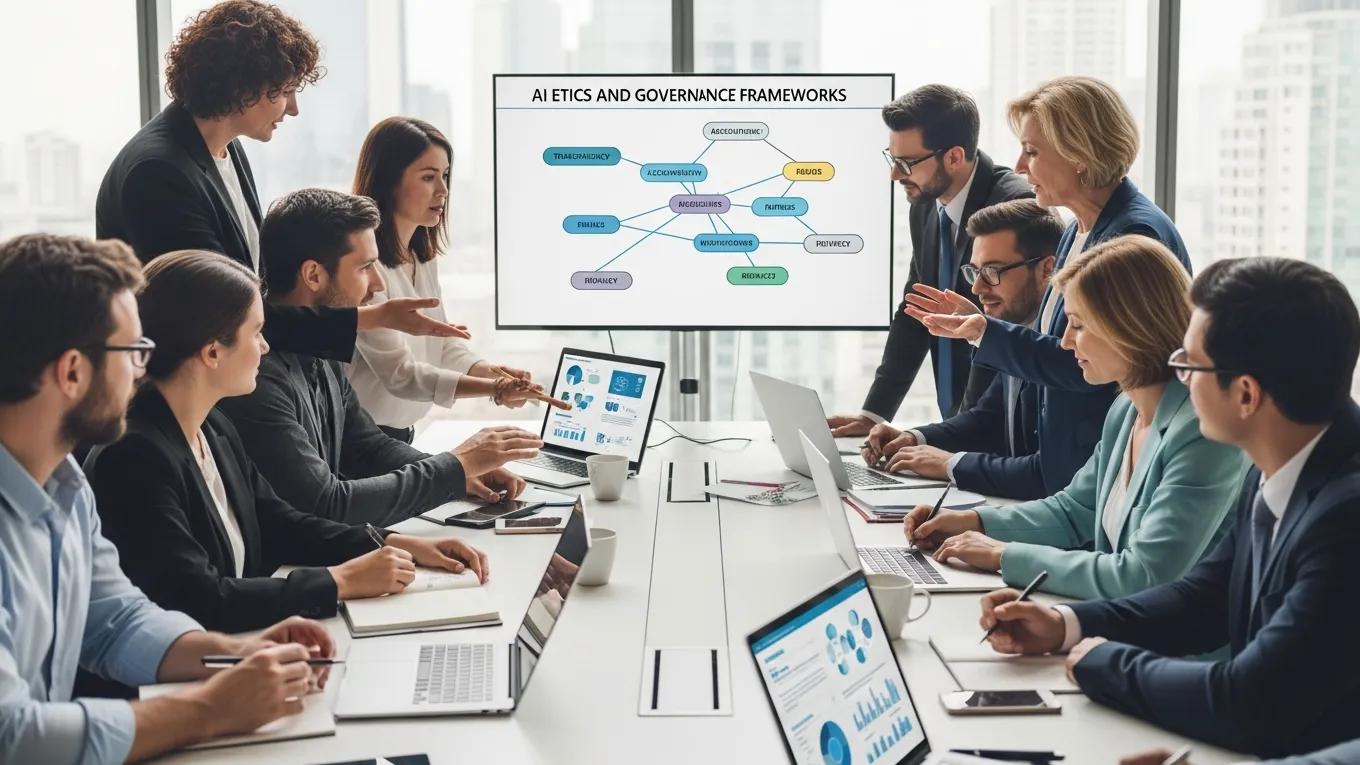
AI governance frameworks define the processes and controls required to align AI deployments with ethical obligations and regulatory requirements. They establish accountability structures, transparency expectations, and compliance mechanisms to manage technical and organizational complexity. Clear governance provisions enable sustained innovation while maintaining oversight. Industry standards serve as practical benchmarks for governance best practices and operational consistency.
Defining AI Governance: Concepts and Industry Standards
AI governance comprises the policies, procedures, and standards that regulate responsible AI development and use. It delineates roles and responsibilities, enforces legal and ethical compliance, and implements accountability mechanisms for system outcomes. Standards issued by bodies such as ISO and IEEE provide implementation frameworks that support consistent governance across organizations. Adoption of these standards improves transparency and strengthens stakeholder confidence in AI systems.
A robust conceptual framework for AI regulation is crucial for establishing sustainable governance and ensuring that AI deployment aligns with societal values.
AI Regulation: A Conceptual Governance Framework
This article presents a conceptual framework for regulating artificial intelligence that addresses all stages of contemporary public policy formation, from foundational elements to sustainable governance. It is based on a systematic review of the literature on Artificial Intelligence Regulation (AIR) published between 2010 and 2020, which the author synthesizes to clarify the “framework” concept. The resulting integrative model consolidates 21 prior depictions of the policy-making process and is oriented toward societal objectives such as fairness, freedom, and long-term sustainability.
Artificial intelligence regulation: a framework for governance, CD Dos Santos, 2021
Balancing Innovation and Risk in AI Adoption
AI presents tangible innovation opportunities alongside operational, legal, and ethical risks that require active management. Effective risk management includes systematic risk assessments, formal data governance, bias mitigation controls, and compliance monitoring. Embedding ethical AI practices and governance checkpoints allows organizations to pursue innovation within defined risk tolerances.
How Does Technology Integration Enhance Creative Practice and Artistic Innovation?
The adoption of technology has transformed creative production by introducing AI capabilities that modify workflows and expand artistic possibilities. This section evaluates the role of AI tools in artistic processes and identifies tool categories that materially influence creative outcomes.
AI-Driven Tools Transforming Artistic Workflows

AI-driven tools are applied across visual arts, music composition, and related disciplines to generate concepts, automate repetitive tasks, and augment technique. Machine learning systems can analyze existing artworks to recommend styles or methods, enabling controlled experimentation by practitioners. The operational efficiencies achieved through these tools reduce cycle times and broaden practical avenues for artistic exploration.
Further research highlights how advanced machine learning models are specifically designed to predict and generate artistic styles, showcasing AI’s transformative role in creative processes.
AI & Machine Learning for Artistic Style Prediction
Machine learning models developed to forecast artistic styles utilize advanced algorithms that extract abstract, hierarchical representations from large datasets of historical and contemporary images. These models rely on deep neural network architectures, including convolutional neural networks (CNNs) and generative adversarial networks (GANs), to identify salient visual features and stylistic patterns. By applying machine learning techniques, these approaches address limitations of traditional methods and deliver results with greater precision and reliability (Mao2022; Wenjing and Cai20
Using machine learning to predict artistic styles: an analysis of trends and the research agenda, VG Pineda, 2024
Case Studies: Successful AI Applications in Creative Industries
Empirical case studies demonstrate AI applications across creative industries, including algorithmic music composition, generative visual art, and production support in film. These implementations illustrate how AI can augment human creativity and generate outputs that integrate technological methods with artistic practice. Analysis of such cases provides operational insights into AI’s capacity to enhance creative workflows and drive innovation.
What Are Effective Risk Management Strategies for AI Implementation in Enterprises?
Enterprise AI implementation requires identification of operational, legal, and reputational risks and the development of targeted mitigation strategies. This section outlines key risk management approaches to support reliable AI deployment at scale.
Identifying and Mitigating AI-Related Business Risks
Organizations should initiate comprehensive risk assessments to evaluate AI impacts on processes, data privacy, and algorithmic fairness. Mitigation measures include formal data governance policies, documented compliance programs, and training to promote ethical AI practices. Proactive identification and remediation of risks increase organizational resilience and adaptability during AI adoption.
Compliance and Ethical Considerations in AI Deployment
Regulatory and ethical compliance are fundamental to responsible AI deployment. Organizations must monitor regulatory developments and incorporate privacy safeguards, bias mitigation, and transparency measures into system design. Prioritizing compliance reduces legal exposure, limits reputational harm, and reinforces stakeholder trust.
How Can Enterprise AI Strategy Drive Digital Transformation Leadership?
A clearly defined enterprise AI strategy provides the governance, capabilities, and operational alignment necessary to lead digital transformation. This section examines the strategic elements and executive responsibilities required to realize AI-driven change.
Frameworks for Enterprise Systems Innovation and Optimization
Enterprises can adopt established frameworks to integrate AI into systems while aligning technical execution with strategic objectives. These frameworks formalize processes for innovation, system optimization, and performance measurement, enabling improved operational efficiency and structured transformation.
This perspective is further supported by research emphasizing the critical role of a comprehensive enterprise-scale AI and analytics strategy in driving end-to-end business transformation.
Enterprise AI Strategy for Business Transformation
In 2023, global enterprises accelerated artificial intelligence (AI) adoption as a strategic lever for competitive advantage and operational reinvention. The referenced study recommends an Enterprise-Scale AI and Analytics Strategy that combines AI capability maturity analysis with a systematic Enterprise AI Roadmap to stage value transformation. The model places analytics-led transformation and intelligence enablement at the center to integrate AI into daily business operations rather than treating it as experimental.
Enterprise-Scale AI and Analytics Strategy for End-to-End Business Transformation across Global Organizations, 2023
Leadership Roles in Guiding AI-Enabled Digital Change
Effective leadership requires substantive understanding of AI technologies and their implications for business processes. Executives must establish governance structures, allocate resources for capability development, and promote cross-functional collaboration. Leaders also must communicate strategic objectives clearly and ensure alignment of AI initiatives with organizational priorities to achieve sustained transformation.
What Consulting Services Support Integrating Art and Technology in Business Practice?
Consulting services provide specialized expertise to assist organizations in integrating art and technology. This section outlines service categories and the operational benefits they deliver to organizations pursuing technology-enabled creative capability.
Tailored AI Governance Advisory for Executives
Consulting firms provide tailored AI governance advisory to support executive decision-making, including assessments of current governance frameworks, recommendations for best practices, and assistance in developing comprehensive AI strategies. These services help align AI initiatives with industry standards and ethical requirements.
Measuring Business Outcomes from AI and Creative Technology Integration
Assessing the outcomes of AI and creative technology integration requires explicit key performance indicators and robust evaluation methodologies. Consultants can design metrics to quantify effects on creative workflows and business performance, enabling evidence-based decision making for subsequent initiatives.
The table summarizes principal strategies and their respective benefits, underscoring the importance of a structured approach to AI governance and risk management in creative and enterprise contexts.
Frequently Asked Questions
What are the potential ethical concerns associated with AI in creative industries?
Primary ethical concerns include authorship attribution, copyright allocation, and algorithmic bias. Automated generation of creative works raises questions about legal ownership. Biases in training data can reinforce stereotypes or exclude particular artistic traditions. Organizations should adopt ethical guidelines and ensure diverse, representative datasets in model training to support fairness and inclusivity.
How can organizations ensure compliance with AI regulations?
To maintain regulatory compliance, organizations must track applicable laws and update AI governance frameworks accordingly. Regular audits and compliance assessments identify gaps and inform remediation. Structured training on ethical and legal obligations builds organizational accountability and supports responsible system development and deployment.
What role does data privacy play in AI governance?
Data privacy is a core element of AI governance because AI systems frequently process personal data. Organizations must implement data protection controls to satisfy regulations such as GDPR and CCPA. Standard measures include data anonymization, documented consent mechanisms, and secure storage and processing protocols. Prioritizing privacy reduces breach risk and enhances user trust.
How can AI enhance collaboration in creative teams?
AI can improve collaboration by synthesizing inputs, identifying patterns, and supporting ideation processes. Analytical tools can aggregate team contributions and propose concepts, while automation of routine tasks enables team members to concentrate on higher-value creative work. Integrating AI into collaborative workflows increases efficiency and supports coordinated creative output.
What are some examples of successful AI applications in the arts?
Representative applications include AI-generated musical compositions, visual art produced via generative adversarial networks (GANs), and AI-assisted film editing. Tools such as OpenAI’s MuseNet and platforms like DeepArt demonstrate neural-network-based capabilities for composition and style transformation. These examples indicate how AI can augment creative production and generate new media formats.
What skills should leaders develop to manage AI-driven transformations?
Leaders should develop a combination of technical literacy and organizational competencies. Essential skills include understanding AI capabilities and limitations, proficiency in change management, and the ability to foster cross-disciplinary collaboration and innovation. Effective communication is required to articulate strategy and address stakeholder concerns during transformation.
How can organizations measure the success of AI integration in creative practices?
Success measurement requires KPIs aligned with strategic objectives, such as workflow efficiency, output quality, and user engagement. Quantitative metrics should be complemented by qualitative feedback from creative teams. Ongoing analysis of these indicators supports evidence-based evaluation and iterative strategy refinement.
Conclusion
Structured integration of art and technology under disciplined AI governance enhances creative outcomes and operational efficiency. Understanding governance principles and implementing risk management frameworks enables organizations to navigate AI adoption while sustaining innovation. These practices position executives to lead digital transformation and capture the organizational benefits of AI. Learn how our consulting services can support your organization’s integration of art and technology.