


Operationalizing Models and MLOps for Risk: Strategic Frameworks and Best Practices for Enterprise AI Governance
Organizations that operationalize AI models must address both deployment mechanics and associated risk controls. This article presents strategic frameworks and operational best practices for implementing Machine Learning Operations (MLOps) within risk management programs. It outlines core elements of automated deployment, the function of monitoring and analytics tools, and governance constructs that support compliance. The subsequent sections describe integrating risk analytics into model lifecycles and the role of continuous monitoring in enabling proactive risk mitigation.
What Are the Core Components of Model Deployment Automation in Risk Management?
Model deployment automation comprises defined workflows, version control, testing gates, and integration points with enterprise systems. These components enable repeatable deployments, consistent configuration management, and traceability across environments. Automating deployment reduces human error, improves operational consistency, and shortens time to production, supporting faster adaptation to changing operational conditions and regulatory requirements.
How Does Automated Model Deployment Enhance Risk Mitigation?

Automated deployment enhances risk mitigation by enforcing repeatable update procedures and integrated monitoring. Automated retraining pipelines that consume new labeled data preserve model relevance and accuracy. Empirical case studies indicate that organisations employing automated deployment experience lower operational risk by accelerating responses to anomalies and market shifts. This systematic approach also institutionalizes continuous improvement within model operations.
Which Enterprise Systems Support Scalable Model Deployment Pipelines?
Scalable deployment pipelines rely on cloud compute platforms, container orchestration, CI/CD tooling, and enterprise data management systems. Technologies such as Kubernetes provide workload orchestration and horizontal scaling across environments. These capabilities permit organisations to accommodate increased model throughput while maintaining service-level objectives and supporting risk management requirements.
Further research documents how MLOps-driven multi-cloud data platforms enable scalable enterprise analytics and banking risk intelligence through automated deployment pipelines.
MLOps for Enterprise Risk Intelligence & Automated Deployment
The referenced research proposes a machine learning and MLOps-driven multi-cloud data platform engineered for scalable enterprise analytics and banking risk intelligence. The framework employs distributed data storage, automated deployment pipelines, and cross-cloud orchestration to support efficient data processing, real-time analytics, and predictive risk assessment. Standard MLOps practices—model versioning, continuous integration, automated testing, and reproducibility—are applied across cloud platforms to reduce deployment errors and operational overhead.
Machine Learning and MLOps-Based Multi-Cloud Data Platforms for Scalable Enterprise Analytics and Banking Risk Intelligence, 2025
How Do Machine Learning Monitoring Tools Facilitate Continuous Risk Assessment?
Machine learning monitoring tools provide continuous observability of model performance, data quality, and input distributions. They expose key performance indicators (KPIs) and surface anomalies that may signal emerging risks. By applying analytics to telemetry and prediction outcomes, organisations obtain actionable signals for remediation and governance interventions. Continuous monitoring therefore underpins compliance and ensures models operate within defined risk tolerances.
What Are the Best Practices for Implementing Real-Time Model Monitoring?
Effective real-time monitoring begins with clearly defined objectives and selected KPIs tied to business and compliance outcomes. Implement automated alerting for threshold breaches, instrument telemetry across the pipeline, and schedule periodic reviews of monitoring effectiveness. Routine evaluation of alerts and metrics supports iterative refinement. Case evidence demonstrates that proactive monitoring reduces incident duration and improves model reliability.
How Does Continuous Model Feedback Improve AI Risk Management?
Continuous feedback loops capture model outputs and operational outcomes for systematic analysis. These loops enable identification of performance degradation, bias emergence, and shifting data distributions. Iterative refinement based on observed outcomes improves model accuracy and resilience to evolving risks. Organisations that implement structured feedback mechanisms report stronger compliance postures and greater ability to navigate regulatory requirements.
What Frameworks Define Effective Enterprise AI Governance for Risk Compliance?
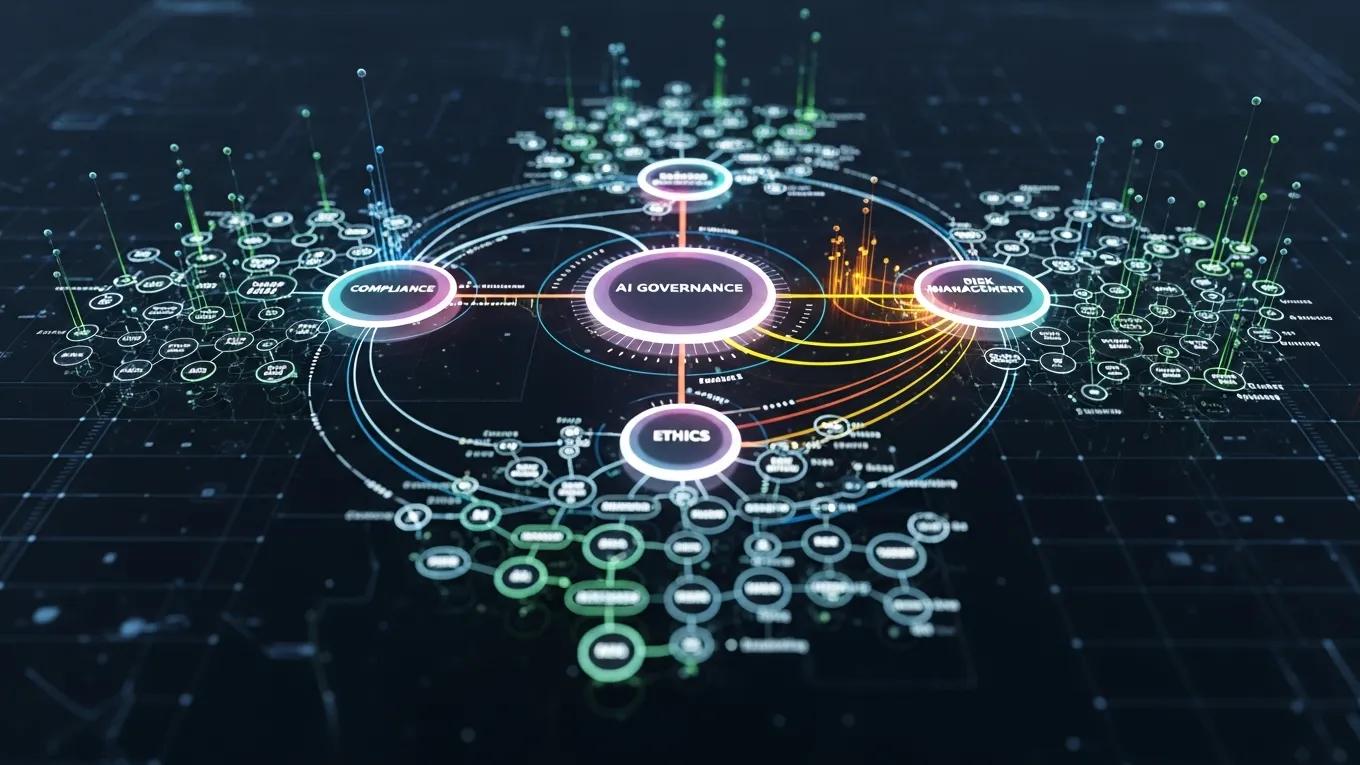
Enterprise AI governance frameworks establish policy, roles, and controls to ensure regulatory compliance and responsible model use. Core elements include data governance, model lifecycle management, auditability, and accountability structures. Implementing these governance components reduces exposure to risks such as algorithmic bias and data privacy violations and creates an auditable foundation for responsible AI aligned with organisational and regulatory obligations.
How Do AI Governance Frameworks Ensure Regulatory and Ethical Compliance?
Governance frameworks codify specific compliance measures such as routine audits, documentation of decision logic, and stakeholder review processes. They incorporate mechanisms for transparency, recordkeeping, and external reporting where required. Successful frameworks integrate diverse stakeholder input to align system design with ethical standards and legal obligations, thereby reinforcing trust and accountability in AI deployments.
A unified governance approach for regulated domains such as healthcare and finance reinforces the need to embed responsible AI principles and continuous assurance into MLOps pipelines.
Unified Risk-Aware AI Governance for Enterprise MLOps
The paper outlines a unified, risk-aware AI governance framework customised for rural healthcare clinics and cloud-based financial systems. Both sectors increasingly adopt AI workflows and therefore face elevated exposure to cyber threats, data integrity issues, and operational vulnerabilities. The framework integrates responsible AI principles, domain-specific regulatory requirements, and continuous assurance practices into DevOps and MLOps pipelines. It highlights adaptive risk scoring, explainability standards, privacy preservation, and compliance-aligned monitoring to protect patient and financial data.
A Risk-Aware AI Governance Framework for Rural Clinics and Cloud Financial Systems: Cybersecurity Strengthening and Autonomous Threat Detection in DevOps …, 2025
What Role Does Risk-Aware MLOps Play in Governance Structures?
Risk-aware MLOps embeds risk management controls throughout the model lifecycle, from design and validation to deployment and decommissioning. This integration ensures risk considerations are operationalised at each stage and that governance requirements are executable within pipelines. Empirical examples demonstrate that risk-aware MLOps improves compliance outcomes and supports ethical deployment practices.
This perspective aligns with frameworks that prioritise continuous monitoring, drift detection, and governance across the ML lifecycle to maintain risk-aware MLOps.
Risk-Aware MLOps Framework for AI Governance & Monitoring
The article proposes a risk-aware operational framework for MLOps that emphasises continuous monitoring, drift detection, and governance at every stage of the machine learning lifecycle.
Risk-Aware MLOps: Managing Model Drift, Compliance, and Accountability in Automated DevOps Pipelines, 2024
How Can Risk Management With AI Be Operationalized Through MLOps Pipelines?
Operationalising AI risk management through MLOps pipelines requires embedding risk analytics, controls, and governance checkpoints into development and deployment workflows. This integration enables data-driven decision support and consistent application of mitigation measures. When executed systematically, MLOps pipelines align model operations with regulatory obligations and organisational risk policies.
What Strategies Integrate Risk Analytics Into AI Model Lifecycles?
Applicable strategies include implementing risk assessment protocols during model design, applying predictive analytics to forecast exposure, and instrumenting robust monitoring for post-deployment validation. These measures should be codified in development standards and acceptance criteria. Adoption of these strategies strengthens detection of emerging risks and contributes to more resilient model portfolios.
How Does Continuous Monitoring Support Proactive Risk Mitigation?
Continuous monitoring provides real-time visibility into model behavior and data shifts, enabling early detection of anomalies. Timely remediation based on monitoring outputs prevents escalation of issues and reduces potential loss. Integrating monitoring into routine operations supports regulatory compliance and sustains model performance over time.
Which Metrics and KPIs Are Essential for Monitoring Enterprise AI Performance and Risk?
Essential metrics for enterprise AI monitoring include model accuracy and calibration, data quality and integrity indicators, and compliance-related measures such as audit coverage and policy adherence rates. Tracking these KPIs yields actionable insight into model health and governance posture and informs prioritisation of mitigation activities.
How Are Risk Indicators Quantified in AI Operational Environments?
Quantification of risk indicators relies on defined measurement methodologies, including statistical performance tests, historical loss analysis, and scenario-based stress testing. Applying these quantitative techniques produces comparable risk metrics that support informed mitigation decisions and resource allocation.
What Tools Enable Effective Tracking of MLOps Pipeline Efficiency?
Tools that support MLOps efficiency tracking include monitoring dashboards, performance analytics platforms, and automated reporting systems. These tools provide telemetry on pipeline throughput, latency, and error rates, allowing teams to identify bottlenecks, optimise workflows, and improve operational reliability. Improved pipeline efficiency also contributes to more effective risk management.
The table summarises how specific tool classes contribute to MLOps pipeline oversight and support organisational risk management objectives.
Frequently Asked Questions
What are the key challenges in implementing MLOps for risk management?
Key challenges include ensuring data quality and representativeness, integrating MLOps processes with legacy IT systems, and securing personnel with combined expertise in machine learning and risk management. Addressing these challenges requires governance, tooling, and workforce development aligned with operational requirements.
How can organizations ensure the ethical use of AI in risk management?
Ensuring ethical AI use requires formal ethical guidelines, governance controls, and regular audits to assess bias and decision transparency. Engaging diverse stakeholders during model development and providing targeted training for staff further supports accountable deployment practices.
What role does data governance play in MLOps for risk management?
Data governance establishes standards for data quality, access control, and usage policies that are essential for trustworthy model outcomes. Effective governance reduces the likelihood of breaches, inaccuracies, and regulatory non-compliance and thereby strengthens the reliability of AI-driven risk management.
How can organizations measure the success of their MLOps initiatives?
Success is measured through defined KPIs such as model performance metrics, deployment frequency, incident response times, and compliance rates. Operational indicators—time to deploy and update cadence—also reflect pipeline efficiency. Regular reviews and feedback loops enable continuous alignment with business objectives.
What are the implications of regulatory changes on MLOps practices?
Regulatory changes necessitate updates to compliance protocols, monitoring configurations, and governance controls. Organisations must track relevant regulatory developments and adapt tooling, model validation procedures, and documentation practices to maintain compliance and avoid legal or reputational risk.
How can organizations foster a culture of continuous improvement in AI risk management?
Fostering continuous improvement requires structured communication channels, cross-functional collaboration, and periodic training initiatives. Implementing feedback mechanisms and recognising contributions to governance and operational enhancements encourages sustained engagement and incremental process refinement.
Conclusion
Operationalising AI models with robust MLOps frameworks strengthens risk management through enforced compliance, structured monitoring, and integrated risk analytics. These practices enable organisations to identify and mitigate issues proactively and to maintain model performance within regulatory parameters. The insights derived from automated deployment and monitoring improve decision quality and organisational resilience; our tailored solutions can assist organisations in navigating the complexities of AI governance.