


Comprehensive Performance Benchmarks for AI and Operations: Measuring Enterprise Efficiency and Risk
Organizations require rigorous performance benchmarks to evaluate artificial intelligence (AI) initiatives and operational processes. Benchmarks function as objective measures that enable comparison, tracking, and validation of technology investments. This article examines the primary performance metrics for AI and operations, their relationship to digital transformation efforts, and the governance and risk-management practices that support reliable deployment. The objective is to provide practitioners with a clear framework for assessing KPIs, aligning governance, and reducing AI-related operational risk.
What Are the Key AI Performance Metrics for Enterprise Benchmarking?
AI performance metrics provide a structured method to quantify system effectiveness and operational impact. Defined KPIs enable alignment between model performance and business objectives, support prioritization of technical debt, and inform governance decisions. These metrics directly affect resource allocation, go/no-go decisions, and longer-term strategic planning.
Research underscores the core evaluative questions enterprises must address when assessing end-to-end AI solution performance.
Enterprise AI Benchmarks: Performance Metrics & Needs
Artificial Intelligence (AI) is now the center of attention for many industries, ranging from private companies to academic institutions. While domains of interest and AI applications vary, one concern remains unchanged for everyone: How to determine if an end-to-end AI solution is performant? As AI is spreading to more industries, what metrics might be the reference for AI applications and benchmarks in the enterprise space? This paper intends to answer some of these questions.
Requirements for an enterprise AI benchmark, 2018
Defining AI Adoption KPIs and Their Impact on Operational Success
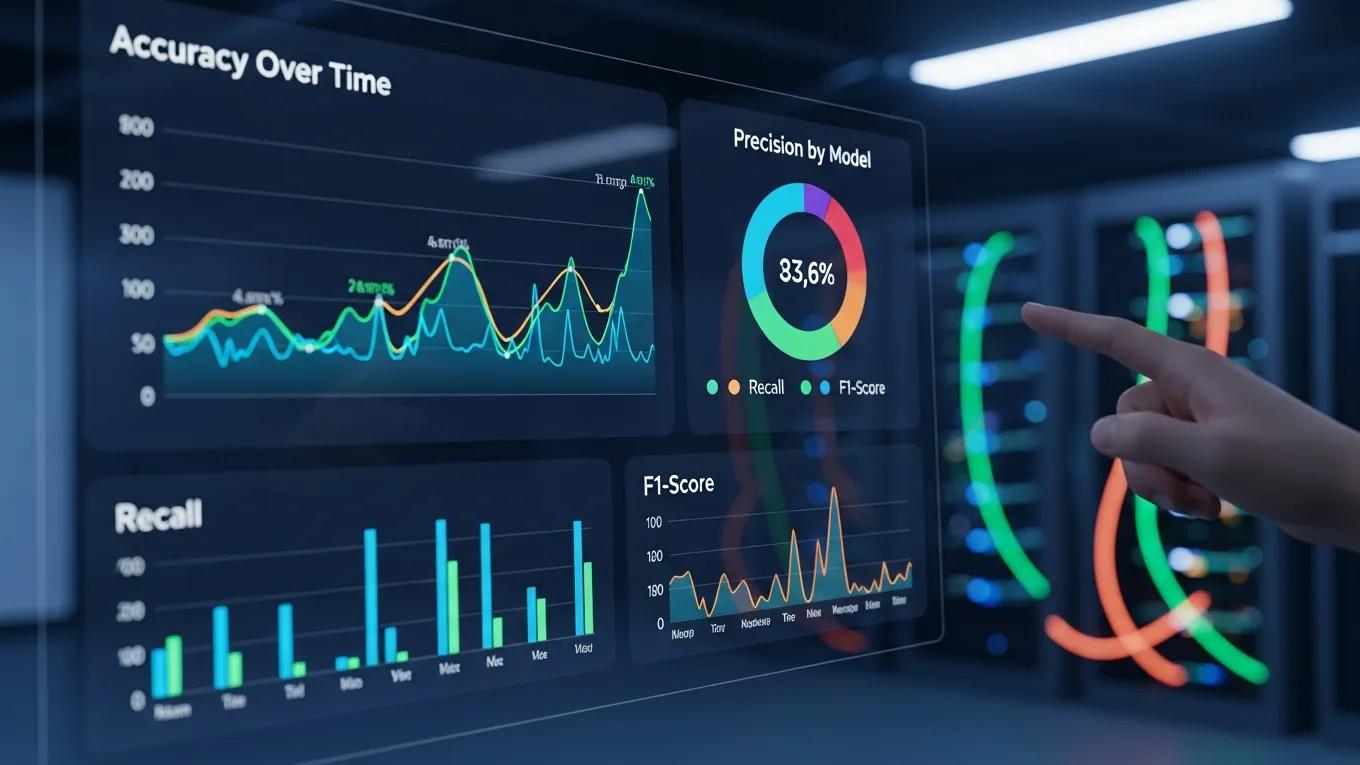
Standard KPIs for AI adoption include accuracy, precision, recall, and F1 score, which quantify predictive performance and error characteristics. These measures inform model selection, deployment thresholds, and monitoring specifications. Consistent tracking of these indicators supports trend analysis and evidence-based adjustments to models and operational processes.
How Do Enterprise AI Benchmarks Drive Digital Transformation Outcomes?
Enterprise benchmarks create objective baselines against which transformation initiatives can be measured. Comparing internal performance to sector benchmarks identifies capability gaps and prioritizes investments. Organizations that operationalize benchmark data can systematically reduce process variance, improve customer-facing workflows, and allocate R&D resources more effectively, thereby strengthening market position.
How Do AI Governance Standards Influence Operational Benchmarking?
AI governance standards define the policies and controls that shape benchmarking practices. Governance provides the compliance, ethical, and operational guardrails necessary for consistent measurement and reporting. Adherence to these standards ensures that benchmarks reflect both technical validity and regulatory obligations.
Core Components of AI Governance Frameworks in Enterprise Systems
Typical governance frameworks incorporate accountability structures, transparency requirements, and ethical principles. These components establish ownership for model outcomes, define disclosure practices for stakeholders, and set constraints that limit harmful behavior. Integrating these elements into benchmarking ensures that performance metrics are interpretable, auditable, and actionable.
Integrating Risk Management in AI Governance for Performance Optimization
Risk management within AI governance identifies and mitigates deployment threats such as data privacy breaches and algorithmic bias. Organizations should implement controls including periodic audits, bias testing, and access governance to reduce exposure. Regular assessments enable targeted remediation and incremental performance improvements.
Which Operational Efficiency Metrics Best Reflect AI-Driven Enterprise Performance?
Operational efficiency metrics reveal how effectively AI contributes to resource utilization and process optimization. Metrics must be selected to reflect the specific operational objectives being measured, enabling clear interpretation of AI impact on throughput, latency, and cost-efficiency.
Measuring Process Improvements Through AI-Enabled Benchmarking Tools
AI-enabled benchmarking tools apply analytics to operational data to identify bottlenecks and quantify improvements. These tools typically report on cycle time, throughput, and resource utilization, supporting hypothesis-driven optimization and documented, reproducible gains in efficiency.
Evaluating Enterprise Innovation Metrics in AI-Integrated Operations
Innovation metrics—such as number of new product releases, time to market, and customer satisfaction indices—measure the downstream effects of AI integration on organizational capability. Tracking these indicators provides evidence of AI’s contribution to product development velocity and market responsiveness, informing investment decisions.
What Are Best Practices for Risk Management in AI Performance Benchmarks?
Robust risk management is a prerequisite for credible AI benchmarking. Organizations should establish processes to identify, quantify, and mitigate risks, ensuring that benchmark results are reliable and that performance improvements do not introduce unacceptable exposures.
Identifying and Mitigating AI Operational Risks with Benchmarking Frameworks

Risk identification is the initial phase of mitigation strategies. Benchmarking frameworks enable systematic assessment of exposure and support development of controls. Scheduled performance reviews and targeted risk assessments provide early detection of vulnerabilities and guide corrective actions.
The design quality of benchmarking frameworks determines their diagnostic utility, as demonstrated by assessment studies of benchmark methodologies.
AI Benchmark Assessment: Capabilities, Risks & Best Practices
AI models are increasingly prevalent in high-stakes environments, necessitating thorough assessment of their capabilities and risks. Benchmarks are popular for measuring these attributes and for comparing model performance, tracking progress, and identifying weaknesses in foundation and non-foundation models. They can inform model selection for downstream tasks and influence policy initiatives. However, not all benchmarks are the same: their quality depends on their design and usability. In this paper, we develop an assessment framework considering 40 best practices across a benchmark’s life cycle and evaluate 25 AI benchmarks against it.
Betterbench: Assessing ai benchmarks, uncovering issues, and establishing best practices, A Reuel, 2024
Case Studies Demonstrating Effective AI Risk Management Strategies in 2026
Documented case studies provide empirical evidence of risk-management approaches and their operational outcomes. Organizations that implemented formal risk frameworks report measurable reductions in model failures and operational incidents, supporting the efficacy of proactive governance and continuous monitoring.
How Can Enterprises Implement and Monitor AI Performance Benchmarks Effectively?
Effective implementation of benchmarks requires defined processes, governance, and tooling for continuous monitoring. Establishing roles, data pipelines, and performance thresholds enables repeatable measurement and timely intervention when metrics deviate from expected ranges.
Utilizing Interactive Benchmarking Tools and Structured Data for Continuous Improvement
Interactive tools and structured datasets facilitate visualization and longitudinal analysis of performance metrics. Dashboards that present real-time indicators support rapid response to deviations and provide the evidence base for iterative improvement cycles.
The table summarizes operational efficiency metrics that organizations should monitor to evaluate AI-driven performance. Regular measurement of these indicators supports targeted interventions and quantifiable operational improvement.
Understanding and applying performance benchmarks for AI and operations enables organizations to improve efficiency and control risk. By selecting relevant metrics, enforcing governance standards, and implementing risk-management best practices, enterprises can manage digital-transformation initiatives with greater predictability and sustained value realization.
Frequently Asked Questions
What are the common challenges organizations face when implementing AI performance benchmarks?
Common challenges include the absence of standardized metrics, complexity in integrating disparate data sources, and organizational resistance to process change. Cross-functional misalignment of priorities can also impede benchmark adoption. Addressing these issues requires governance, data engineering investments, and stakeholder engagement to ensure benchmarks map to operational objectives.
How can organizations ensure the accuracy of their AI performance metrics?
Accuracy is achieved through robust data validation, controlled experiment design, and periodic audits. Implementing data quality checks, establishing ground-truth datasets, and conducting regular performance reviews reduce measurement error and support reliable benchmarking.
What role does employee training play in the success of AI performance benchmarks?
Structured training equips personnel to interpret metrics, operate monitoring tools, and act on insights. Competency development fosters consistent use of benchmarks, improves governance adherence, and enables informed decision-making across technical and business teams.
How can organizations leverage AI to improve their operational efficiency metrics?
Organizations can deploy AI analytics to detect inefficiencies, forecast demand, and optimize resource allocation. Applying predictive models to operational data enables prescriptive interventions that reduce cycle times, increase throughput, and lower operating costs.
What are the best practices for integrating AI governance into performance benchmarking?
Best practices include defining governance roles, documenting policies for model development and monitoring, and implementing transparent reporting. Regular governance reviews and compliance checks ensure benchmarks remain aligned with ethical and regulatory requirements.
How can organizations measure the impact of AI on customer satisfaction?
Measure impact using pre- and post-deployment comparisons of customer feedback surveys, Net Promoter Score (NPS), and retention metrics. Correlating these outcomes with operational changes attributable to AI provides evidence of customer-facing value.
Conclusion
Effective performance benchmarks for AI and operations are essential for enterprises pursuing operational excellence and risk control. Consistent metric selection, integrated governance, and disciplined risk management enable organizations to operationalize AI with measurable outcomes and sustained benefits.