


Curated Reading for Leaders & Practitioners: Comprehensive AI Governance Frameworks and Enterprise Strategy Insights
This compendium provides executives and practitioners with curated resources to evaluate AI governance frameworks and enterprise strategy. It summarizes essential frameworks, risk‑management practices, and leadership development materials to support effective AI implementation. Informed decision‑making enables organizations to realize AI value while mitigating operational, legal, and ethical risks. The guide addresses key governance models, the role of curated reading in executive development, risk mitigation practices for AI adoption, and how enterprise AI strategies support performance optimization.
What Are the Essential AI Governance Frameworks for Enterprise Leaders?
AI governance frameworks consist of documented policies, processes, and controls that govern the ethical, legal, and operational dimensions of AI systems. For enterprise leaders, these frameworks supply a structured roadmap for responsible deployment, regulatory compliance, and stakeholder assurance. Robust governance defines accountability, auditability, and incident‑response procedures, thereby strengthening operational resilience. Representative frameworks include the European Union’s AI Act and the OECD Principles on AI, which articulate requirements for transparency, fairness, and accountability.
How Do AI Governance Frameworks Mitigate Enterprise Risk?
Governance frameworks mitigate AI risk by specifying roles, approval gates, and compliance checks across the model lifecycle. Organizations with mature frameworks reduce exposure to operational incidents such as data breaches and algorithmic bias and thereby protect regulatory standing and reputation. These frameworks also codify monitoring, validation, and remediation workflows that support continuity and recovery in AI operations.
Recent research highlights AI’s role in strengthening operational resilience through predictive analytics, automated response mechanisms, and dynamic system optimization across disruption scenarios.
AI for Enterprise Operational Resilience & Risk Management
Operational resilience has become a foundational element of enterprise sustainability in a volatile, digitally interconnected economy, where disruptions—ranging from cyberattacks and supply chain breakdowns to geopolitical instability and regulatory change—require proactive and adaptive risk management. Artificial Intelligence contributes capabilities in predictive analytics, autonomous decisioning, and dynamic system optimization that enable organizations to withstand and adapt to such disruptions. This research article provides an exhaustive examination of AI’s role in strengthening operational resilience, with emphasis on security, scalability, and intelligence‑driven adaptability.
AI-powered operational resilience: Building secure, scalable, and intelligent enterprises, 2022
Which Industry Standards Define Effective AI Governance?
Industry standards provide benchmarks for AI governance and inform organizational best practices. Relevant standards include ISO/IEC 27001 for information security management and ISO/IEC 38500 for corporate governance of IT. These standards emphasize risk assessment, stakeholder engagement, documented controls, and continuous improvement. Adherence to such standards helps align AI initiatives with regulatory expectations and stakeholder requirements.
How Can Curated Reading Lists Enhance Leadership Development in AI Strategy?

Curated reading lists compile prioritized literature to accelerate executive competency in AI strategy. They provide concise syntheses of frameworks, practical case studies, and implementation guidance that support strategic planning and governance design. Executives can apply these insights to develop governance models, roadmaps, and capability plans. Curated lists also facilitate engagement with subject‑matter experts and relevant professional networks.
What Are the Top Recommended Books and Articles on AI Strategy for Executives?
Executives seeking targeted strategic guidance should consider foundational works that combine market analysis and implementation guidance. Notable recommendations include “AI Superpowers” by Kai‑Fu Lee, which examines the competitive landscape of AI, and “The AI Advantage” by Thomas H. Davenport, which presents practical approaches to implementing AI in business. These resources offer strategic perspectives and actionable recommendations for enterprise adoption.
How Do Curated Resources Support Digital Transformation Initiatives?
Curated resources support digital transformation by presenting actionable frameworks, implementation patterns, and exemplar case studies. Leaders can extract reproducible practices for governance, organizational design, and technology adoption. These resources also reinforce the necessity of continuous learning to monitor emerging technologies and evolving business models.
What Are the Key Risk Management Practices in AI Adoption for Enterprises?
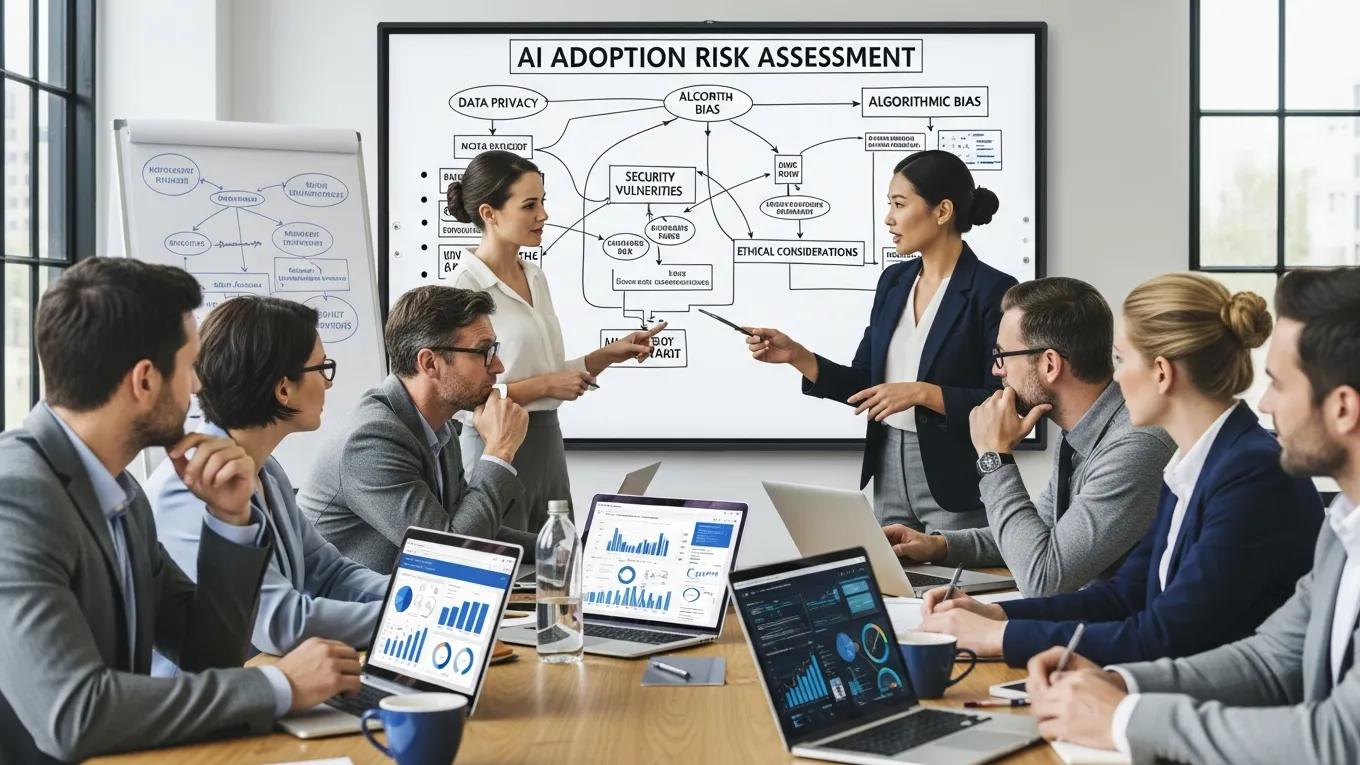
Effective risk management for AI adoption requires systematic identification, assessment, and mitigation of AI‑specific risks. Core practices include comprehensive risk assessments, formally established governance structures, model validation and monitoring, and defined escalation procedures. These measures enable organizations to capture AI benefits while controlling legal, ethical, and operational exposures.
Which Risks Are Most Common in Enterprise AI Implementations?
Common risks in enterprise AI deployments include data privacy and protection issues, algorithmic bias, and operational disruptions arising from model failures or integration errors. Addressing these risks requires data protection controls, diverse and representative training datasets, rigorous model validation, and continuous monitoring throughout production.
A recent paper examines the ethical considerations required for robust AI deployment, with focus on security, regulatory compliance, and bias mitigation.
Ethical AI Frameworks for Enterprise Automation & Risk Mitigation
This paper examines the ethical dimensions of Artificial Intelligence in enterprise automation, stressing the need to balance security, regulatory compliance, and bias mitigation. While AI technologies optimize operations and support decision‑making, their adoption introduces ethical and control challenges related to data security and potentially biased outcomes. The study reviews existing literature, industry practice, and case studies to inform an ethical framework that emphasizes transparency, accountability, fairness, privacy, and continuous oversight in AI system design.
Ethical AI in Enterprise Automation: Balancing Security, Compliance, and Bias Mitigation, 2025
How Can Leaders Implement Risk Mitigation Strategies Effectively?
Leaders implement risk mitigation by instituting transparent governance, clearly defined roles and responsibilities, and stakeholder engagement across the model lifecycle. Effective programs incorporate training, documented procedures, and resourcing to ensure staff can identify and remediate AI‑related risks. Established reporting and escalation channels support timely response to incidents.
How Do Enterprise AI Strategies Drive Performance Optimization?
Enterprise AI strategies are designed to improve organizational performance by embedding AI capabilities into core processes to increase efficiency, reduce cost, and enhance decision quality and customer outcomes. Successful strategies combine technology, data governance, and organizational change, with ongoing measurement and adaptation to maintain alignment with business objectives and market conditions.
This strategic integration is supported by analyses of how AI extends decision processes beyond static analytics to dynamic, AI‑augmented frameworks.
AI-Driven Decision Intelligence for Enterprise Strategy
Artificial intelligence‑driven decision intelligence constitutes a significant shift in enterprise strategy formulation and execution. The article examines the transition from traditional decision processes—characterized by manual interventions and static analytics—to dynamic, AI‑augmented frameworks that enable proactive responses to complex business environments. Despite large volumes of operational data, many enterprises struggle to convert that data into actionable intelligence, creating a gap between data collection and strategic utilization.
AI-Driven Decision Intelligence: Optimizing Enterprise Strategy with AI-Augmented Insights, PK Natta, 2025
What Frameworks Support AI-Driven Enterprise Innovation?
Several established frameworks support AI‑driven innovation by providing structured methodologies for data analytics and model development. The CRISP‑DM (Cross‑Industry Standard Process for Data Mining) framework specifies a systematic approach to data analysis and model lifecycle management that yields actionable insights. The Agile methodology complements this approach by enabling iterative development, rapid prototyping, and faster feedback cycles.
How Is AI Impact Measured in Enterprise Performance Metrics?
Measuring AI impact requires selecting key performance indicators aligned with strategic objectives. Typical KPIs include improvements in operational efficiency, cost reductions, customer satisfaction scores, and the rate of successful AI project deployments. Regular review of these metrics, complemented by qualitative stakeholder feedback, supports data‑driven adjustments to AI strategies.
What Are the Latest Trends and Case Studies in AI Governance and Leadership?
Maintaining awareness of current trends in AI governance and leadership is essential for executives responsible for technology and risk. Emerging areas of emphasis include ethical AI practices, explainable AI, and the maturation of data governance frameworks. Understanding these trends enables leaders to exploit opportunities while addressing regulatory and operational challenges.
Which 2026 AI Governance Trends Should Leaders Monitor?
For 2026, several governance trends merit attention: the development of regulatory frameworks targeting AI ethics, the formal integration of AI considerations into corporate governance, and an intensified focus on data privacy and security. Monitoring these trends supports compliance and competitive positioning.
What Case Studies Demonstrate Successful Enterprise AI Innovation?
Multiple case studies document successful enterprise AI initiatives across sectors. For example, a major retail organization implemented AI‑driven inventory management, yielding measurable cost reductions and improved customer satisfaction. A financial institution applied AI‑based fraud detection to enhance real‑time risk identification and mitigation. These examples illustrate the strategic impact of targeted AI adoption.
How Can Leaders Access Advisory and Speaking Services for AI Strategy?
Organizations may engage advisory and speaking services to obtain expert guidance on AI governance, strategy, and implementation. External advisors and speakers provide synthesized insights, practical recommendations, and case examples that assist executive decision‑making and organizational planning.
What Consulting Services Does Dr George Dagliyan Offer for AI Governance?
Dr. George Dagliyan provides consulting services in AI governance, enterprise systems innovation, and risk management. His practice supports the development of governance frameworks and the design of AI strategies tailored to specific organizational contexts, enabling leaders to operationalize responsible AI initiatives.
How Do Speaking Engagements Support Executive Leadership Development?
Speaking engagements deliver targeted briefings on emerging trends, best practices, and case studies that inform executive leadership. These events facilitate knowledge transfer, stimulate strategic discussion, and contribute to a culture of continuous learning within organizations.
Frequently Asked Questions
What are the key components of an effective AI governance framework?
An effective AI governance framework typically comprises clear accountability structures, documented ethical guidelines, compliance mechanisms aligned with legal standards, and formal risk‑management processes. It should include stakeholder engagement and continuous monitoring and evaluation capabilities to adapt as AI technologies and regulations evolve. Together these components support transparency, trust, and effective management of AI systems.
How can organizations ensure compliance with AI regulations?
Organizations ensure regulatory compliance by maintaining awareness of applicable laws and standards, such as the European Union’s AI Act, and by conducting regular audits of AI systems. Compliance programs should include employee training, documented policies, and reporting mechanisms for governance issues. Collaboration with legal counsel and industry bodies provides additional guidance in a dynamic regulatory environment.
What role does stakeholder engagement play in AI governance?
Stakeholder engagement ensures that diverse perspectives inform AI governance decisions. Involving employees, customers, regulators, and other relevant parties helps identify risks, ethical concerns, and operational impacts. This collaborative approach strengthens transparency, supports risk identification, and improves alignment between AI initiatives and organizational and societal expectations.
How can leaders measure the success of their AI strategies?
Leaders measure AI strategy success by defining and tracking specific KPIs aligned with business objectives, such as operational efficiency gains, cost savings, customer satisfaction improvements, and project delivery rates. Regular metric reviews and stakeholder feedback enable evidence‑based adjustments and continuous improvement.
What are the challenges of implementing AI governance frameworks?
Implementing AI governance frameworks presents challenges including organizational resistance to change, limited understanding of AI technologies, and the difficulty of aligning governance with existing corporate structures. Additional challenges include keeping pace with evolving regulations and addressing ethical concerns. Overcoming these challenges requires investment in training, stakeholder engagement, and clear change management processes.
How can curated reading lists be tailored for specific leadership needs?
Curated reading lists can be tailored by aligning selected resources with the organization’s strategic priorities and operational challenges. Leaders should identify themes such as ethical AI, risk management, or digital transformation and select materials that provide actionable guidance. Including diverse perspectives and practical case studies enhances applicability and supports informed decision‑making.
Conclusion
Applying comprehensive AI governance frameworks and targeted curated reading enables leaders to navigate AI implementation with greater rigor. These practices support informed decision‑making, mitigate risk, and optimize performance. Engaging expert advisory services and tailored resources is instrumental to advancing AI governance and leadership development; explore advisory services to elevate your AI governance and leadership development today.