


Consulting Services for Operational Telemetry
Operational telemetry constitutes a foundational element of contemporary risk management, enabling organizations to monitor system state and analyze operational signals in real time. This article examines the architecture and deployment considerations for telemetry, its function in risk monitoring, and design practices for effective implementation. The discussion addresses signal capture frameworks, metric definition methodologies, and the integration of AI governance within telemetry pipelines to support digital transformation objectives.
What is Operational Telemetry and Its Role in Risk Monitoring?
Operational telemetry denotes the systematic collection and analysis of performance and health data from distributed systems to detect anomalies and support operational decisions. Real-time telemetry improves risk management by surfacing indicators of degradation and enabling timely remediation. The principal benefit is the production of actionable signals that guide decision processes, improve operational efficiency, and reduce risk exposure.
Practical deployments, particularly in industrial environments, further demonstrate telemetry’s role in sustaining operational performance.
Telemetry for Industrial Operational Performance
This paper emphasizes the value of a new wireless telemetry system that is used to maintain the operational performance of industrial information systems.
The value of a telemetry monitoring system in sustaining the operational performance of industrial information systems, MJ Mathews, 2020
Defining Operational Telemetry in Enterprise Systems
Operational telemetry comprises multiple data acquisition mechanisms, including physical sensors, system and application logs, and application performance monitoring (APM) agents. These data sources are combined to construct an integrated view of system state. Integration with existing enterprise systems and data pipelines is necessary to ensure consistent data flow and enable analytics that identify trends, detect anomalies, and support evidence-based operational decisions.
How Does Telemetry Enhance Risk Detection and Management?
Telemetry enhances risk detection through continuous monitoring and predictive analytics. AI-driven diagnostic models analyze multi-source telemetry to identify anomalous patterns and forecast potential failures prior to impact. This proactive posture supports risk mitigation, process optimization, and sustained operational resilience by reducing time-to-detection and enabling targeted interventions.
Subsequent research outlines how AI-enhanced telemetry can improve predictive accuracy and system reliability at scale.
AI Telemetry for Enterprise Predictive Reliability
This paper proposes an AI-driven telemetry analytics framework that unifies predictive reliability and privacy-preserving observability for large-scale enterprise systems. The framework employs machine learning–based anomaly detection and cross-layer correlation of metrics, traces, and logs to predict service degradation before it impacts critical business operations.
AI-Driven Telemetry Analytics for Predictive Reliability and Privacy in Enterprise-Scale Cloud Systems, S Devalla, 2025
How to Design Effective Signal Capture Frameworks for Telemetry?
Effective signal capture frameworks are required to realize the value of operational telemetry. A disciplined framework specifies which signals to capture, the sampling and aggregation strategy, and the ingestion patterns that ensure data integrity and analytical utility.
What Are the Components of the Signal Capture Framework k5?
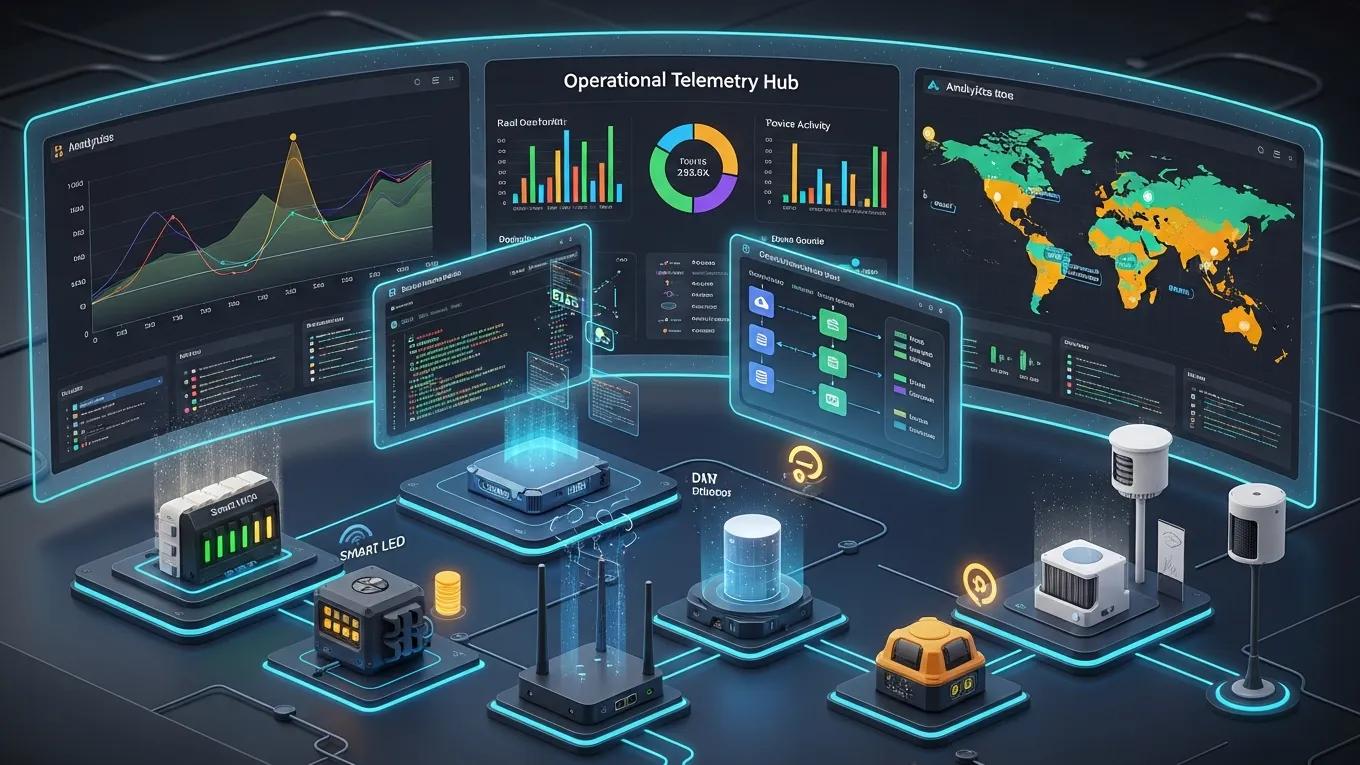
The k5 signal capture framework comprises defined data sources, integration interfaces, and analytics components. Data sources include IoT endpoints, application logs, telemetry agents, and user interaction traces. Integration mechanisms ensure reliable data transport into analytics platforms. Analytics modules perform processing, correlation, and visualization to extract operational insights.
Best Practices for Implementing Signal Processing in Telemetry
Implementing signal processing requires clear collection objectives, robust data integration tooling, and continuous performance monitoring. Practices include defining signal schemas, applying appropriate filtering and aggregation, and instituting routine framework reviews to accommodate changing system topologies and evolving analytical requirements.
Which Metrics Define Effective Telemetry for Risk Monitoring?
Effective telemetry depends on well-defined metrics that quantify system health and operational risk. Selected metrics should directly map to business-critical objectives and provide measurable indicators for performance, reliability, and security.
How to Develop Metric Definition Guides k5 for Operational Telemetry
Developing metric definition guides for k5 requires a formalized process: specify metric names, measurement units, collection frequencies, aggregation rules, and interpretation thresholds. Clarity in definitions ensures consistent implementation and enables stakeholders to interpret metrics uniformly across teams.
What Are Key Performance Indicators in Enterprise Telemetry Solutions?
Key performance indicators for enterprise telemetry typically include system uptime, latency and response time distributions, error and exception rates, and mean time to detection (MTTD). These KPIs enable quantitative assessment of telemetry effectiveness and inform adjustments to risk management practices.
What is the Role of AI Governance in Telemetry and Risk Management?

AI governance establishes policy, oversight, and controls for AI components within telemetry pipelines to ensure compliance, fairness, and operational safety. Governance frameworks align AI usage with regulatory requirements and organizational risk tolerances.
How Do AI Risk Management Frameworks Integrate with Telemetry Systems?
AI risk management frameworks integrate by defining risk identification, assessment, and mitigation processes specific to AI models and their telemetry inputs. This includes model validation, monitoring of model drift, and incorporation of telemetry signals into governance workflows to maintain model performance and compliance.
Why Is Explainability Important in AI-Driven Telemetry?
Explainability is necessary to validate AI-driven inferences and to provide traceable rationale for automated recommendations. Transparent model behavior supports stakeholder confidence, enables regulatory compliance, and facilitates root-cause analysis during incident response.
Work on AI-driven telemetry for complex network environments underscores the requirement for explainability and rigorous evaluation.
AI-Driven Telemetry Framework for Network Operations
This section presents the experimental findings and analytical evaluation of the proposed AIdriven telemetry framework for Ultra Ethernet and InfiniBand networks.
Explainable AI (XAI) for
Network Operations and Troubleshooting, O Aramide, 2025
How Does Operational Telemetry Support Digital Transformation Initiatives?
Operational telemetry supports digital transformation by providing empirical data to inform strategy, automate operational workflows, and enable faster, evidence-based decision making. Telemetry systems supply the signal fidelity required for analytics-driven business transformation.
What Are the Benefits of Telemetry in Enterprise Systems Innovation?
Telemetry delivers measurable benefits for enterprise innovation: increased operational efficiency, improved predictive maintenance capabilities, and a structured basis for continuous improvement. Access to timely operational data enables identification of optimization opportunities and programmatic innovation.
How to Leverage Telemetry Data Analytics for Real-Time Risk Monitoring?
Leveraging telemetry for real-time monitoring requires applying advanced analytics, including statistical anomaly detection and supervised or unsupervised machine learning, to identify deviations from baseline behavior. These techniques enable proactive interventions and strengthen organizational resilience.
What Are Industry Best Practices and Case Studies Demonstrating Telemetry Impact?
Industry best practices and case studies provide empirical evidence of telemetry implementations and their operational impact. Documented examples elucidate implementation patterns, measurable outcomes, and lessons learned for effective deployment.
Which Case Studies Illustrate Successful Operational Telemetry Implementations?
Case studies across sectors illustrate how telemetry has been applied to improve performance, reduce operational risk, and accelerate innovation. Extracted recommendations and implementation patterns from these cases serve as practical references for enterprise deployments.
What Are Emerging Trends in Telemetry and Risk Monitoring for 2024-2026?
Emerging trends for 2024–2026 include expanded adoption of AI and machine learning for predictive observability, heightened emphasis on data privacy and governance, and increased integration of IoT endpoints to broaden telemetry coverage. Organizations should monitor these trends to maintain telemetry relevance.
Frequently Asked Questions
What are the key challenges in implementing operational telemetry systems?
Primary implementation challenges include heterogeneous data integration, ensuring data integrity and quality, and the technical complexity of real-time analytics. Integrating telemetry from diverse sources can produce schema and consistency challenges. Sustaining high data quality is essential for reliable insights. Additionally, real-time analytics often require specialized personnel and robust infrastructure, which may increase implementation costs.
How can organizations ensure data privacy while using telemetry?
Organizations can protect privacy by implementing formal data governance, strong encryption for data in transit and at rest, and anonymization or pseudonymization of sensitive fields prior to ingestion. Compliance with regulations such as GDPR should be validated through periodic audits and documented controls. Employee training on data handling procedures reinforces governance practices.
What role does machine learning play in enhancing telemetry systems?
Machine learning enhances telemetry by enabling predictive analytics, automated anomaly detection, and pattern discovery across high-dimensional data. ML models trained on historical telemetry can surface early indicators of failure and optimize operational processes. Additionally, automation of routine analysis reduces manual effort and improves time-to-insight.
How can organizations measure the ROI of their telemetry investments?
ROI assessment requires quantifying both direct and indirect benefits. Direct metrics include reductions in downtime, decreases in incident resolution time, and improvements in resource utilization. Indirect benefits encompass enhanced decision quality, compliance outcomes, and customer satisfaction. Comparing these benefits to implementation and operating costs provides a comprehensive ROI evaluation.
What are the future trends in operational telemetry for risk management?
Future trends include broader deployment of AI/ML for closed-loop operations, advanced visualization and observability tooling, and tighter integration of IoT telemetry. Concurrently, governance frameworks will evolve to address privacy and ethical considerations while preserving analytical value.
How can organizations train their staff to effectively use telemetry systems?
Effective training combines structured courses on telemetry tools and data interpretation, hands-on workshops using production-like datasets, and continuous learning through updates and refresher sessions. Mentorship and cross-functional knowledge transfer facilitate practical skill development and improve operational adoption.
Conclusion
Operational telemetry is integral to modern risk management, supplying real-time observability and predictive analytics that enable informed decision making. When implemented with rigorous metric definitions, signal capture frameworks, and appropriate AI governance, telemetry improves efficiency, reduces exposure to operational risk, and supports continual improvement. Understanding these components allows organizations to respond to evolving challenges and pursue innovation. Learn how our solutions enable organizations to leverage operational telemetry to support strategic objectives and operational resilience.