


Contact Dr. George Dagliyan for AI Governance and Control Tools
Effective governance of artificial intelligence (AI) is essential for organizations seeking to mitigate operational, compliance, and ethical risks. This article examines the principal tools for AI governance and controls and their role in strengthening enterprise risk management and regulatory compliance. It analyzes core functions of AI governance platforms, the operational impact of policy automation, and the governance function of model inventory management. As AI adoption grows, proficiency with these tools supports regulatory adherence and controlled innovation. The article reviews policy-automation mechanisms, model-inventory processes, and implementation best practices to provide a comprehensive overview of their contribution to enterprise governance.
Research further underscores AI governance as foundational to trust, regulatory compliance, and ethical accountability within enterprise systems.
AI Governance Frameworks for Enterprise Compliance & Ethics
This paper evaluates AI governance frameworks as foundational mechanisms for addressing transparency, accountability, legal compliance, and ethical responsibility in public-sector enterprise environments. It documents requirements for explainability, fairness, and alignment with democratic values under heightened regulatory scrutiny.
AI Governance in Public Sector Enterprise Systems: Ensuring Trust, Compliance, and
Ethics, J Bhat, 2024
What Are AI Governance Platforms and Their Core Functions?
AI governance platforms are integrated systems for governing AI deployments within organizations. They support regulatory compliance and enforce ethical guardrails while consolidating governance capabilities for monitoring model performance, assessing risk, and implementing controls. Core functions include policy automation, model inventory management, and compliance tracking, which together strengthen governance and oversight of AI systems.
Defining AI Governance Platforms in Enterprise Contexts
Within enterprise environments, AI governance platforms function as the structural foundation for overseeing AI initiatives. They enable formal policy definition, continuous compliance monitoring, and impact assessment relative to organizational objectives and regulatory standards. A robust governance framework reduces deployment risk and improves operational efficiency.
Key Features: Policy Automation, Model Inventory, and Compliance Tools
Governance platforms provide features that standardize governance workflows. Policy automation enables creation, versioning, and enforcement of AI policies to satisfy legal and ethical requirements. Model inventory tools maintain a comprehensive register of deployed models to support transparency and accountability. Compliance modules track adherence to external regulations and internal policies and generate analytics to identify risk exposures and remediation actions.
How Does Policy Automation Software Improve Regulatory Compliance?
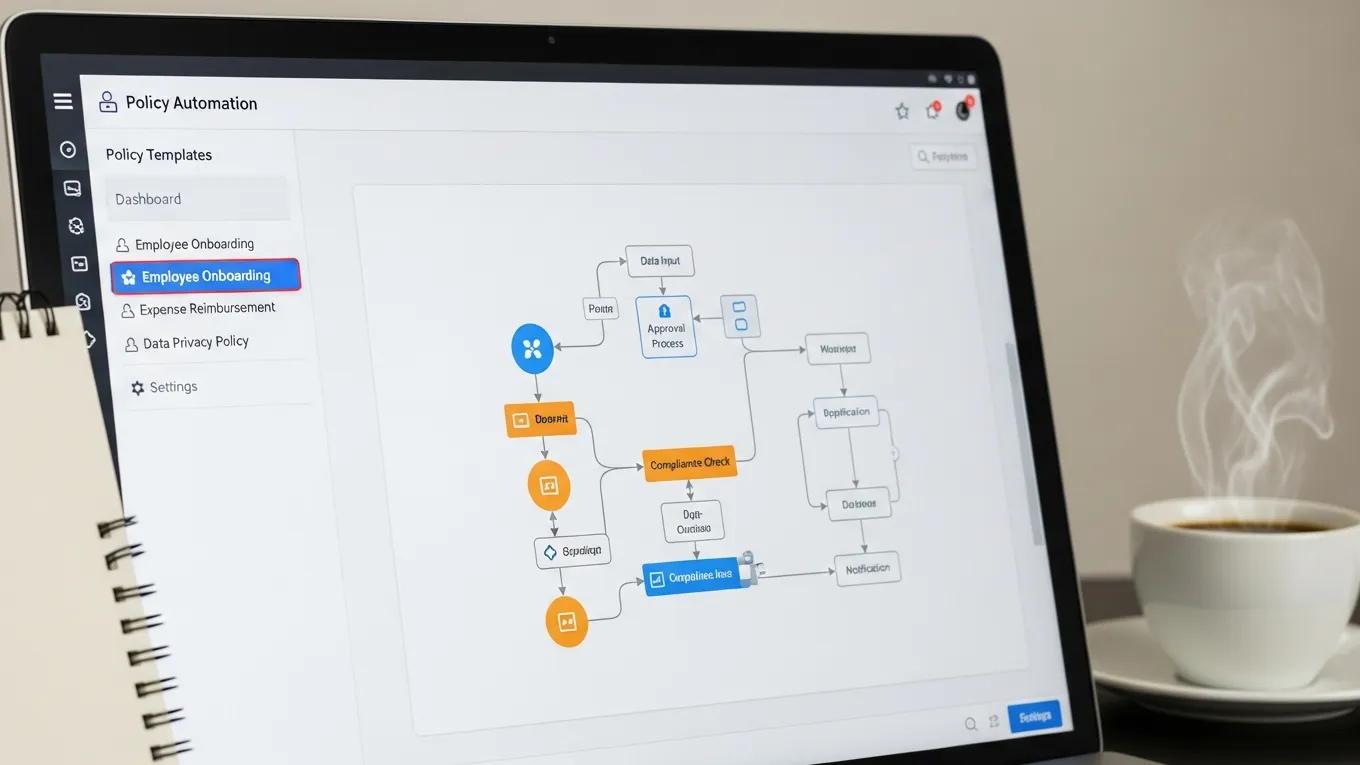
Policy-automation software enhances regulatory compliance by standardizing policy development and enforcement within AI governance programs. Automation ensures consistent application of policies and enables timely updates in response to changes in regulatory requirements.
Mechanisms of Policy Automation in AI Governance
Policy automation employs software for drafting, approval, and distribution of governance policies across the enterprise. Typical components include templates, workflow orchestration, and role-based approvals to streamline the policy lifecycle and stakeholder collaboration. Automated update mechanisms enable rapid adaptation to new regulatory requirements, thereby reducing the risk of noncompliance.
This method aligns with frameworks that advocate scalable, policy-driven data governance and the application of policy-as-code for continuous compliance verification.
Scalable AI Data Governance: Policy-Driven Frameworks for Enterprise Compliance
This paper evaluates data-governance models for AI-enabled architectures across cloud, edge, and on-device accelerators, emphasizing the need to scale across data velocity, heterogeneity, and varied regulatory regimes. It proposes a layered, policy-driven framework that separates a global control plane from distributed data planes to enable consistent enforcement while preserving local autonomy. A metadata-centric “governance fabric” integrates catalogs, lineage, quality signals, and data contracts; policy-as-code then encodes access controls, purpose limitation, retention, and residency via declarative rules and continuous compliance checks.
Scalable Data Governance Models for AI-Powered Computing Architectures, 2022
Impact on Compliance Efficiency and Risk Mitigation
Policy automation reduces manual processing, decreasing error rates and ensuring uniform policy enforcement. These efficiencies improve compliance posture and lower operational risk associated with AI deployment. Organizations that adopt automated policy controls can accelerate compliance responses and strengthen accountability and transparency.
Dr. George Dagliyan, an established expert in AI governance, provides consulting and advisory services on governance tooling, policy automation, and model inventory management. His advisory support assists organizations in implementing governance strategies tailored to their operational and regulatory requirements.
What Role Does Model Inventory Management Play in AI Risk Management?

Model inventory management is a fundamental element of AI risk management, providing mechanisms to maintain transparency and accountability for deployed models. A detailed inventory enables systematic assessment of deployment risks and informed governance decisions.
Maintaining Transparency Through Model Inventory Tools
Model inventory systems establish a centralized repository for deployed AI models, enabling performance tracking and compliance verification against governance policies. Accurate inventories facilitate rapid identification and remediation of model-related risks and support proactive governance processes.
Case Studies Demonstrating Model Inventory Effectiveness
Case studies demonstrate that organizations implementing comprehensive model inventories achieved improved regulatory compliance and enhanced risk-assessment capabilities. These findings underscore the operational value of maintaining current inventories to support governance and risk-management practices.
Which AI Compliance Tools Are Essential for Enterprise Governance?
Determining essential AI compliance tools is necessary for strengthening governance frameworks. Such tools integrate compliance controls into AI governance workflows to manage risk and ensure adherence to applicable regulatory requirements.
Integrating Compliance Tools with Governance Frameworks
Integrating compliance tools with governance frameworks streamlines compliance operations. Aligning compliance controls with governance policies produces a cohesive risk-management approach and ensures that compliance functions operate as an integral component of governance.
Measuring Compliance Outcomes and Audit Trail Capabilities
Evaluating compliance outcomes requires tools that generate audit trails and measurable metrics. Audit-capable systems provide traceability of compliance activities and enable identification of areas for improvement. Analysis of compliance data supports evidence-based adjustments to governance processes and enhances overall risk management.
How Do AI Governance Tools Support Digital Transformation Strategies?
AI governance tools support digital transformation by ensuring AI initiatives align with strategic objectives and regulatory obligations. Effective governance reduces implementation risk and facilitates scalable, compliant adoption of AI technologies.
Aligning AI Governance with Enterprise Digital Transformation
Integrating AI governance into enterprise digital-transformation programs ensures AI initiatives contribute to organizational objectives while meeting regulatory standards. Clear governance frameworks assist organizations in managing implementation complexity and accelerating adoption.
Strategic alignment enables use of AI-augmented platform governance and automation to drive continuous improvement and build stakeholder trust.
AI-Augmented Enterprise Platform Governance & Automation
The CONNECT Framework addresses enterprise alignment and platform governance through structured principles augmented by intelligent automation: Collaborate for cross-functional alignment; Orchestrate integrated workflows; Normalize architectural standards; Nurture continuous improvement; Enable data-driven decision-making; Cultivate trust and transparency; and Transform for future readiness.
CONNECT Framework for AI-Augmented Enterprise Alignment and Platform Governance, AK Vedantham, 2025
Leveraging AI Governance for Sustainable Innovation
AI governance enables sustainable innovation by enforcing responsible development and deployment practices. Ethical and compliant AI processes reduce operational risk and position organizations to lead in responsible AI adoption.
What Are Best Practices for Implementing and Monitoring AI Governance Tools?
Effective implementation and monitoring of AI governance tools require a defined strategy and governance-aligned processes. Organizations should adopt best practices that support integration of these tools within existing governance structures to ensure operational effectiveness.
Structured Data Markup and Semantic Entity Integration
Structured data markup and semantic entity integration improve the visibility and effectiveness of governance tools. These practices enhance discoverability of governance policies and make relevant information accessible to stakeholders, reinforcing transparency and accountability.
Key Performance Indicators and Continuous Improvement Processes
Defining key performance indicators (KPIs) aligned with governance objectives is essential for monitoring tool effectiveness. Implement continuous improvement cycles so governance strategies adapt to regulatory developments and evolving organizational requirements.
The table summarizes key features of AI governance tools and their applications in enterprise governance.
Integration of comprehensive AI governance tools is necessary for organizations that aim to strengthen risk management and compliance. By deploying policy automation, model inventory management, and compliance tooling, organizations can manage the complexities of AI deployment while maintaining regulatory adherence. Implementing governance best practices supports innovation and establishes organizational leadership in responsible AI. Consult available resources to further optimize AI governance strategy.
Frequently Asked Questions
What are the key challenges organizations face in AI governance?
Organizations face challenges including compliance with evolving regulations, ensuring explainability and transparency in automated decision processes, and managing ethical risks such as bias. Integrating governance frameworks into existing business processes requires cross-functional coordination. Data privacy and model bias present material risks to trust and accountability and must be addressed as part of a comprehensive governance program.
How can organizations measure the effectiveness of their AI governance tools?
Measure effectiveness by establishing KPIs aligned to governance objectives, such as compliance rates, policy-update latency, and model-performance validation accuracy. Conduct regular audits and assessments to evaluate adherence to policies. Gather stakeholder feedback to identify gaps and use empirical findings to refine governance tools and processes in response to regulatory and operational changes.
What role does training play in successful AI governance implementation?
Training ensures stakeholders understand governance frameworks, policies, and tool functionalities. Comprehensive training programs increase compliance awareness and promote ethical decision-making. Ongoing education maintains alignment with regulatory developments and enhances the organization’s capacity to manage AI risks effectively.
How do AI governance tools facilitate collaboration across departments?
Governance tools provide centralized repositories for policy management, compliance monitoring, and model inventories, enabling cross-functional access to shared resources, coordinated policy development, and real-time compliance oversight. This reduces organizational silos and aligns departments with common governance objectives and regulatory requirements.
What are the implications of non-compliance in AI governance?
Non-compliance exposes organizations to legal, financial, and reputational consequences. Regulatory authorities may impose fines or sanctions, and biased or unethical AI systems can trigger litigation and loss of stakeholder trust. To mitigate these risks, organizations must prioritize compliance and implement robust governance frameworks that enforce legal and ethical standards.
How can organizations ensure continuous improvement in their AI governance practices?
Ensure continuous improvement by periodically reviewing governance frameworks based on performance metrics, stakeholder input, and regulatory developments. Implement an assessment-feedback-adaptation cycle and encourage organizational learning to identify and adopt effective governance tools and methodologies that remain relevant in a changing AI landscape.
Conclusion
The integration of comprehensive tools for AI governance and controls is essential for organizations seeking to enhance risk management and compliance. By leveraging policy automation, model inventory management, and compliance tools, organizations can navigate the complexities of AI deployment while ensuring adherence to regulatory standards. Implementing best practices for AI governance will foster controlled innovation and position organizations as leaders in responsible AI practices. Consult available resources to learn more about optimizing your AI governance strategy.